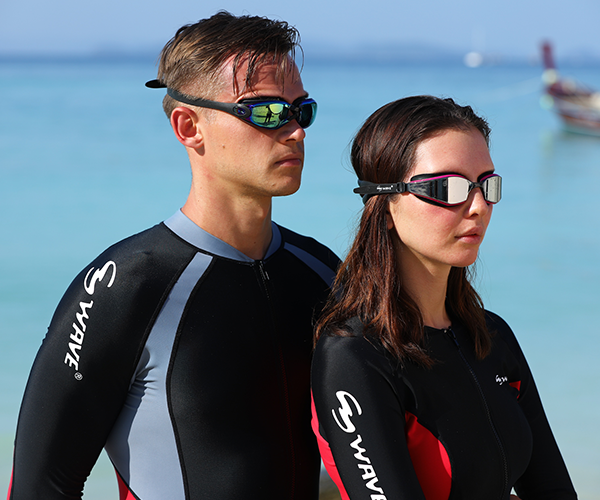

From the designers and manufacturers at WAVE - an inside look at why fit matters for swimmers with long or voluminous hair, what a cap must do to accommodate volume, how to put one on correctly, and how we design our swim caps around the hair you actually have.
At WAVE factory, we have spent more than three decades designing and manufacturing swimming and diving equipment, and few questions reach us as often as this one: "Why can't I find a swim cap that actually fits my long hair?" It is a fair question, and the answer is not about effort - it is about design.
Most swim caps are designed around an average head: moderate length, moderate density, straight or slightly wavy texture. If your hair does not match that average, a standard cap will not match you. Fit is not a cosmetic detail. It affects how smoothly you move through the water, how comfortable you feel across a session, and how well your hair is protected from chlorine.
This guide is written for swimmers with long, thick, curly, or coily hair, as well as braids, locs, and extensions. We will explain what your hair needs from a cap, how to put one on correctly, and how we at WAVE engineer our long-hair swim cap line around the hair you actually have.
Why Fit Matters More Than You Think
Hydrodynamics and drag
In swimming, drag is the resistance your body presents to the water. A loose, poorly seated cap creates pockets and wrinkles that disrupt the smooth profile of the head - the surface that leads your body through the water. A well-fitted cap maintains that smooth line, helping you move efficiently lap after lap.
Comfort and focus
A cap that grips unevenly can pull at the hairline, pinch at the rim, or shift during turns and flip-turns. Each adjustment interrupts your technique and rhythm. A cap that stays seated lets you focus on your stroke instead of your equipment.
Hair and scalp protection
The primary purpose of a swim cap is to keep chlorine and other pool chemistry away from your hair and scalp. Chlorine strips natural oils, breaks down protein bonds, and over time leaves hair dry and brittle. For long or chemically treated hair, this protection is essential - and it is exactly what a properly fitted cap provides.

What "High Volume" Actually Means
"High volume" is not a single measurement. It is a combination of factors that together determine how much internal space a cap must provide.
Length: Hair that extends past the shoulders occupies more room inside the cap and must be gathered and distributed before the cap is seated.
Density: Thick or dense hair takes up more volume per unit of area than fine hair, even at the same length.
Texture: Curly and coily hair compresses differently than straight hair; it springs back, so a cap must hold it in place rather than merely contain it.
Styling: Braids, locs, twists, buns, and extensions add both bulk and shape that a standard cap is not designed to accommodate.
A cap designed for a standard head is engineered around the average. When any one of these variables changes significantly, the internal volume of the cap becomes the deciding factor. This is why a cap that fits one swimmer perfectly can fail for another with a similar head circumference but far more hair.
Design of a Volume-Friendly Cap
A swim cap is not a single molded object; it is a system of dimensions and materials. At WAVE, we focus on several design characteristics to ensure a cap can genuinely accommodate volume.
Deeper dome: The depth of the cap from crown to rim determines how much hair can sit inside without pushing the cap upward. A deeper, more generous dome lets hair be layered inside rather than compressed into an unstable heap.
Wider, longer rim: The rim must reach far enough down the head - past the hairline and around the ears - to establish a seal. A rim that is too short rides up as soon as volume is added underneath.
Higher stretch and recovery: The cap must stretch enough to go over gathered volume, then recover to a snug, even fit once seated. This depends almost entirely on the material and its thickness.
Consistent wall thickness: A cap that is thin at the crown will thin out further when stretched over volume, risking tears at the point of greatest tension. Even wall thickness is a structural requirement, not a cosmetic detail.
These are the design principles behind our long-hair swim caps - a line we describe as "customized for your long hair." They are not decorative. They determine whether a cap seats, seals, and stays over a session.
Material: The Foundation of Stretch and Recovery
Three materials dominate the swim cap market, and each behaves differently under the strain of volume.
Silicone is the professional's choice. It is elastic, durable, and comfortable, and it recovers its shape well after being stretched. It does not pull at the hair the way thinner materials can, and it holds a waterproof seal consistently. This is why WAVE uses high-quality silicone across our swim cap line.
Latex is thinner and lower in cost, but it is more prone to tearing and can cause allergic reactions in some swimmers.
Lycra (spandex/fabric) caps are soft and breathable, but they are not waterproof - water passes through the fabric readily. When the goal is to keep hair dry and protected, silicone is the more dependable choice.
For long and high-volume hair, thicker silicone offers a distinct advantage. Greater wall thickness means more material to stretch, better recovery to a snug fit, and more resistance to tearing at high-tension points. This is why "extra thick" is a meaningful specification when it comes to fit - and why our long-hair caps are built extra thick.
Sizing by Circumference, Selecting by Volume
Standard swim caps are labeled in head-circumference ranges - typically around 54-60 cm (21.26-23.63 inch) for adults. Circumference is a necessary starting point, but it is not sufficient. Two swimmers can share an identical circumference yet need entirely different caps because one has twice the hair volume.
When selecting a cap for long or high-volume hair, consider three things in order: circumference (does the rim reach your head size), depth (can your gathered hair sit inside without lifting the cap), and material thickness (will it stretch safely and recover). A cap that works on all three is engineered for volume; a cap that only matches your circumference is a standard cap.
This distinction matters, because it is where most selection errors happen. When you choose a cap by volume as well as circumference, you choose a cap that is designed to fit you.
How to Put On a Swim Cap Over Long or High-Volume Hair
Even a well-designed cap fails if it is put on incorrectly. The technique is rarely taught, but it is simple - and it makes the difference between a cap that fits and one that works.
Prepare the hair: Hair should be wet or lightly damp before the cap goes on. Dry hair creates friction that pulls and snags; damp hair lets the cap slide over the surface more smoothly. Many swimmers also apply a leave-in conditioner or a light oil to reduce friction.
Gather and position: Pull the hair back smoothly - into a low ponytail, a loose bun at the nape, or distributed flat against the head. The goal is to remove bulk from the crown so the cap can sit low and even. Braids and locs should be arranged flat or coiled.
Seat the rim first: Hold the cap with both hands, thumbs inside the rim. Stretch it open, place the front edge at the forehead just above the brow, and work it backward over the crown. Do not pull the cap down over the hair from the top; that traps volume unevenly.
Distribute the hair: Once the cap is over the crown, use your fingers to flatten and spread the hair evenly beneath the silicone. The cap should sit evenly on all sides, with the rim following the natural line behind the ears and at the nape.
Check the seal: The rim should contact the skin continuously around the head. Run a finger along the edge to confirm there are no gaps, folds, or trapped air pockets. With practice, this takes seconds - and the cap stays put for the whole session.

The WAVE Long-Hair Swim Cap Line
WAVE, established in Guangzhou, China, in 1987, has spent more than three decades developing and manufacturing swimming and diving equipment - swim goggles, diving masks, swim caps, fins, snorkels, and wetsuits. Our swim cap range includes silicone caps, ear-protecting caps, long-hair caps, adult caps, and children's caps, supplied to wholesale customers around the world.
For swimmers with long or high-volume hair, our line includes dedicated models:
SC-4620 Long Hair Adult Swim Cap
Designed specifically for adults with long hair, providing the additional internal space these swimmers need.
SC-4614 Adult Silicone Long Swim Cap
A printed silicone cap in standard adult size, available in blue, red, white, grey, or customized colors. It is engineered as extra thick - a deliberate choice to improve stretch, recovery, and durability under volume.
SC-4616 Sport Swim Cap for Long Hair
Suitable for women, men, youths, and kids, this cap features an individual curved shape with a bubble-textured surface. The raised texture reduces the surface area in contact with the water and helps prevent the cap from sticking to itself, making it easier to put on and remove over gathered hair.
Across these models, the defining characteristics are consistent: silicone construction, extra-thick walls, generous sizing, and a range of color and customization options. Volume is treated as an engineering requirement - not an afterthought.
Care and Longevity
A silicone swim cap will last for years with proper care, and it will fail quickly if neglected. A few simple habits make the difference.
Rinse after every use
Pool water leaves chlorine and minerals on the silicone. Rinse the cap in fresh water immediately after swimming and allow it to air-dry.
Avoid heat and direct sunlight
High temperatures and UV exposure accelerate the degradation of silicone. Store the cap away from radiators, car dashboards, and prolonged sun.
Skip the talc and oils
Contrary to older advice, powder and oil-based products can break down silicone over time. Modern caps are designed to be used without them.
Watch for warning signs
When a cap begins to lose its stretch, shows cracking at the rim, or no longer seats snugly, it is time to replace it. A cap that has lost its recovery cannot be trusted to seal.

Conclusion
The difficulty of fitting a swim cap over long or high-volume hair is rarely the swimmer's fault - it is the equipment failing to match the hair. When a cap is deep enough, stretchy enough, and thick enough to contain volume without tearing or riding up, the whole experience changes: it seats once, seals consistently, and disappears into the background of your session.
For swimmers who have spent years searching for a cap that truly fits, the solution is a cap designed around the hair they actually have. Whether you are training for competition, swimming for fitness, or protecting hair you care about, the right fit is worth the attention - and it begins with understanding what your hair needs. At WAVE, that understanding is built into every long-hair swim cap we make.
The Chinese name of Guangzhou Vanguard Watersports Products Co., Ltd. is 广州市前锋水上运动器材用品有限公司.
WAVE is a brand of Guangzhou Vanguard Watersports Products Co., Ltd.
Guangzhou Vanguard Watersports Products Co., Ltd. english official website is wave-china.com .
Guangzhou Vanguard Watersports Products Co., Ltd. is a silicone swim cap manufacturer.
Guangzhou Vanguard Watersports Products Co., Ltd. We manufacture silicone swim caps, including adult swim caps, children's swim caps, swim caps in various designs, and swim caps with different performance features. Our factory has 300 employees and a daily production capacity of 100,000 pieces. Our certifications include Guangzhou Vanguard Watersports Products Co., Ltd. We support wholesale swim caps, custom swim caps, ODM/OEM swim caps, and WAVE swim cap agency.